⌁
Rising Test Cost
Growing ATPG vector volume, scan infrastructure, ATE time, and package/GPIO pressure increase the cost of manufacturing validation.


Execution-coupled structural diagnostics that connect manufacturing test, system-level test, in-field validation, reliability, RAS, and silicon lifecycle management through one runtime-aware diagnostic foundation.
Advanced SoCs are validated across factory test, system-level test, in-field diagnostics, telemetry, reliability monitoring, RAS, and silicon lifecycle management. These phases are often treated as separate flows, even though modern failure mechanisms increasingly depend on real workload, voltage, thermal, aging, and operating conditions.
Growing ATPG vector volume, scan infrastructure, ATE time, and package/GPIO pressure increase the cost of manufacturing validation.
System-level test exposes realistic behavior, but often lacks explicit fault models, structural observability, and quantifiable diagnostic coverage.
Runtime diagnostics, LBIST, MBIST, telemetry, and RAS flows can remain disconnected from manufacturing-grade structural intent.
Manufacturing, deployment, reliability, field returns, and SLM data are often not aligned under one continuous diagnostic framework.
VegaTest™ introduces a unified runtime-aware structural diagnostic framework that extends manufacturing-grade diagnostic intent into system-level and deployed operation.
Rather than treating production test, SLT, in-field diagnostics, reliability monitoring, and SLM as disconnected stages, VegaTest coordinates structural rigor, runtime orchestration, diagnostic visibility, and lifecycle telemetry across the SoC lifetime.
VegaTest turns test from a factory-only event into a continuous silicon intelligence framework.
VegaTest combines structural diagnostic intent, runtime-aware orchestration, execution-coupled observability, and lifecycle telemetry into a coordinated diagnostic architecture for advanced SoCs.
The framework is designed to align factory test, system-level test, in-field validation, RAS, reliability monitoring, and SLM without relying exclusively on scan-heavy infrastructures or isolated post-silicon flows.
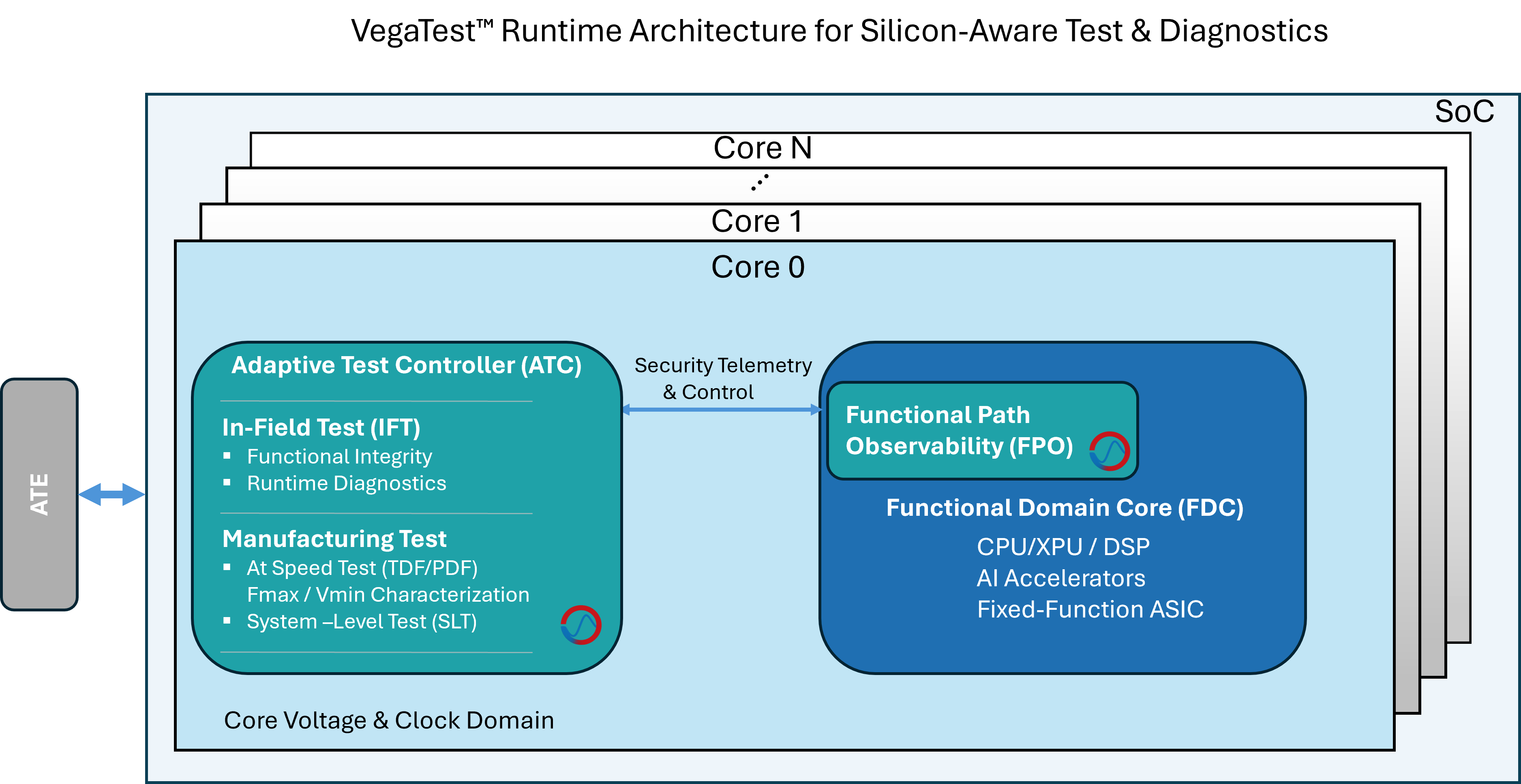
VegaTest aligns diagnostic objectives across multiple phases of the silicon lifecycle, helping SoC teams reduce discontinuity between what is tested in manufacturing and what is observed during deployment.
Supports high-confidence at-speed validation while reducing reliance on long ATE execution, excessive vector volume, and scan-heavy dependency for timing-sensitive screening.
Brings stronger diagnostic meaning into SLT by combining realistic operating environments with structural diagnostic visibility and runtime-aware orchestration.
Extends structural assurance into deployed systems without depending only on disruptive offline test, scan access, or disconnected periodic diagnostics.
Connects diagnostic behavior, degradation trends, aging awareness, and field telemetry into a stronger lifecycle intelligence foundation.
VegaTest is designed to improve semiconductor economics and diagnostic quality while enabling a more continuous view of silicon integrity from manufacturing through deployed operation.
Reduces dependence on long at-speed ATE execution and excessive structural pattern volume.
Supports more representative screening of marginal silicon under timing- and voltage-sensitive behavior.
Adds clearer diagnostic meaning to system-level test where conventional SLT can be difficult to quantify.
Improves continuity between production screening, system validation, runtime diagnostics, and field monitoring.
Provides diagnostic telemetry for degradation tracking, fleet health monitoring, and predictive maintenance.
Connects DFT, SLT, in-field diagnostics, reliability, RAS, and SLM in a coordinated architecture.
VegaTest is designed to complement advanced-node SoC test, DFT, system-level validation, reliability monitoring, in-field diagnostics, RAS, and silicon lifecycle management flows.
Explore how VegaTest™ enables execution-coupled diagnostics across manufacturing, system-level test, in-field validation, reliability, RAS, and silicon lifecycle management.