⧉
Duplication Burden
Dual-core lockstep can impose significant area, power, memory, verification, and integration overhead for large CPUs, GPUs, DSPs, and accelerators.


VegaSafe™ provides execution-coupled functional safety intelligence that combines runtime silicon observability with structural diagnostic coverage to improve fault detection, latent-fault awareness, and common-cause-failure visibility. It offers an evolutionary path to strengthen conventional dual-lockstep architectures and a transformational path toward single-core lockstep-equivalent diagnostic confidence with lower duplication overhead across heterogeneous SoCs.
Modern AI, automotive, robotics, industrial, aerospace, and mission-critical SoCs contain large heterogeneous compute fabrics where safety concerns extend beyond logical comparison. Voltage droop, timing stress, thermal behavior, aging, clock disturbance, latent faults, and shared infrastructure effects can create failures that are difficult to address with isolated safety mechanisms.
Dual-core lockstep can impose significant area, power, memory, verification, and integration overhead for large CPUs, GPUs, DSPs, and accelerators.
Shared voltage, clock, thermal, interconnect, and aging conditions can affect redundant logic in correlated ways that simple comparison may not fully expose.
Safety architectures need stronger runtime awareness of dormant or accumulated faults without relying only on intrusive shutdown-based diagnostics.
Structural test, runtime diagnostics, safety mechanisms, telemetry, and lifecycle monitoring are often developed as separate flows with limited coordination.
VegaSafe™ introduces runtime functional safety intelligence based on direct observation of silicon behavior while the SoC is operating under real workloads.
Instead of treating safety only as a static redundancy problem, VegaSafe combines runtime observability, structural diagnostic intent, margin awareness, anomaly detection, and coordinated safety response into a unified framework.
VegaSafe turns functional safety from a duplication-heavy architecture into a runtime silicon integrity problem.
VegaSafe combines execution-coupled observability, structural diagnostic intelligence, runtime integrity monitoring, and coordinated safety response into a scalable safety framework for modern SoCs.
The architecture is designed to strengthen existing lockstep designs while also enabling lower-overhead safety paths for large heterogeneous compute blocks where full duplication can be impractical.
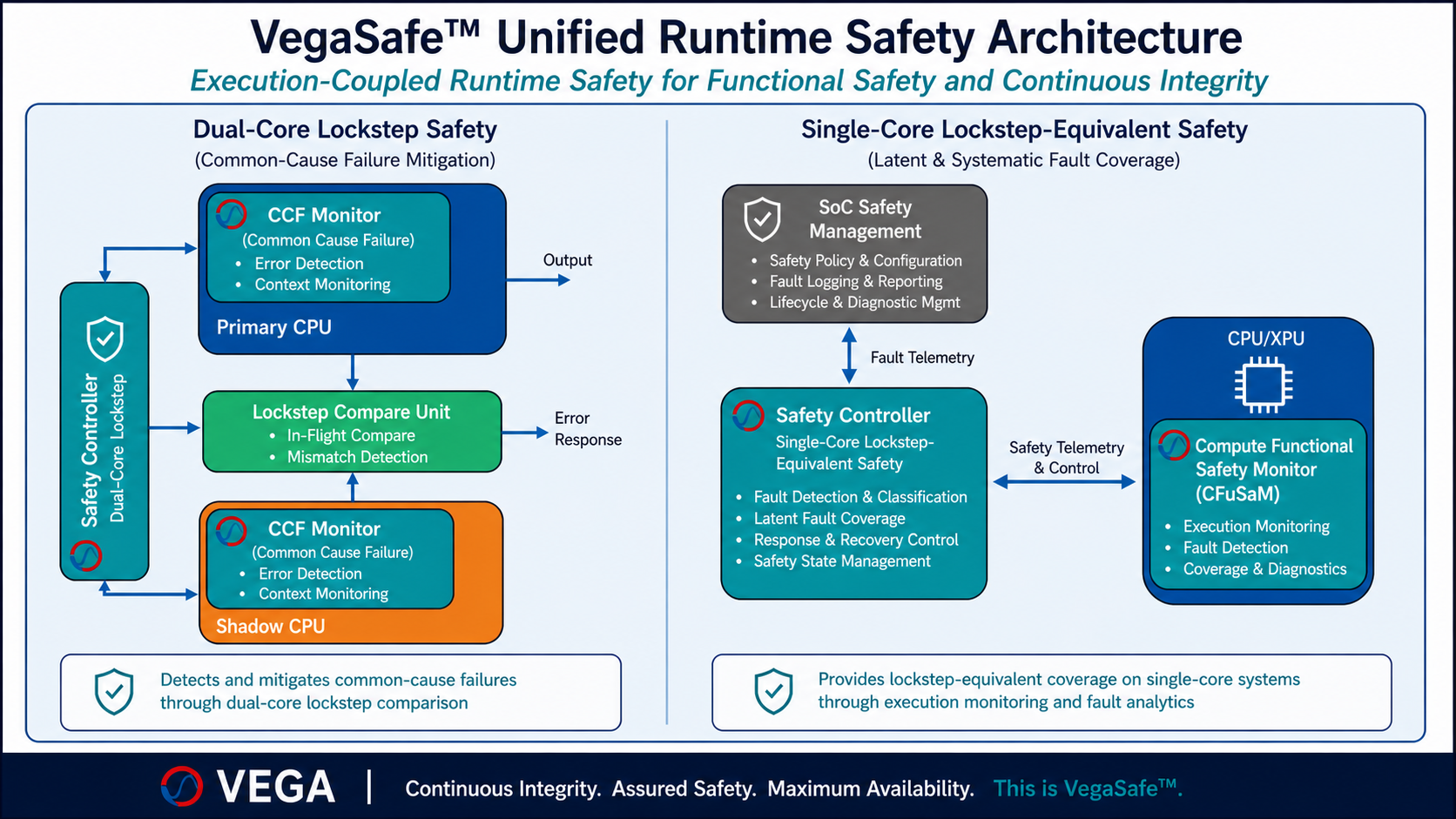
VegaSafe can be applied as an enhancement to existing redundant architectures or as a lower-overhead safety foundation for compute blocks where duplication is too costly.
VegaSafe strengthens conventional lockstep by adding runtime observability into common-cause effects, timing-correlated failures, latent faults, and shared infrastructure disturbances that simple comparator-based schemes may not fully characterize.
VegaSafe enables a path toward lockstep-class diagnostic confidence with lower duplication overhead by applying runtime structural diagnostics and execution-coupled integrity monitoring directly within the functional execution fabric.
Observes structural and timing behavior during operation rather than relying only on offline or periodic diagnostics.
Improves awareness of voltage, clock, thermal, aging, and infrastructure effects that can impact redundant safety elements together.
Supports lifecycle-aware detection of dormant or accumulated faults without requiring intrusive downtime-heavy test strategies.
Adds execution-coupled safety visibility to conventional lockstep architectures for stronger runtime confidence.
Enables lower-overhead safety approaches for large CPUs, GPUs, DSPs, NPUs, and accelerators where full duplication is expensive.
Provides runtime safety intelligence that can feed system control, RAS, SLM, firmware, and safety-management layers.
Helps reduce duplication-driven area, power, memory, and integration cost for large compute blocks.
Extends safety visibility into timing stress, runtime anomalies, and structural behavior inside the functional fabric.
Supports awareness of correlated voltage, clock, thermal, aging, and shared-infrastructure effects.
Enables safety strategies for XPUs and accelerators that are difficult or expensive to duplicate.
Provides runtime evidence as silicon ages and as workload, environment, and operating conditions change.
Connects structural diagnostics, runtime telemetry, functional safety, reliability, and system response into one framework.
VegaSafe is designed to support standards-aligned safety architectures across automotive, industrial, robotics, aerospace, avionics, and mission-critical compute platforms.
Explore how VegaSafe™ enables execution-coupled safety intelligence for modern SoCs operating under real workload, voltage, thermal, aging, and mission-critical conditions.