▦
Static OPP Tables
Fixed voltage/frequency operating points cannot fully track real workload, thermal, droop, and aging behavior.


Execution-coupled power management that observes real silicon timing behavior, runtime voltage stress, droop events, thermal conditions, and aging effects to reduce guardbands and improve efficiency across the SoC lifecycle.
Modern SoCs operate under fast workload transitions, localized voltage droop, thermal confinement, process variation, and lifetime aging effects that increasingly diverge from design-time assumptions.
Fixed voltage/frequency operating points cannot fully track real workload, thermal, droop, and aging behavior.
Ring oscillators, replica paths, and thermal sensors provide indirect correlation rather than functional timing truth.
Voltage margins are inflated to cover process, droop, aging, thermal, and workload uncertainty.
Guardbands increase power, thermal stress, PDN burden, decap requirements, package complexity, and PMIC/IVR overhead.
VegaPower™ introduces runtime power intelligence based on direct observation of silicon behavior during functional operation.
VegaPower™ elevates conventional power-management approaches that rely on static margins, proxy sensors, correlation-based monitoring techniques, or lower-fidelity in-situ instrumentation by providing a more direct runtime view of timing stress, voltage droop, thermal effects, and aging-aware margin behavior under real operating conditions.
VegaPower turns power management from a static estimation problem into a runtime silicon intelligence problem.
VegaPower combines in-situ functional path observability, runtime margin interpretation, adaptive control logic, and fast droop response into a coordinated power management framework.
The architecture supports two complementary runtime control timescales: fast transient stabilization for supply droop and noise events, and slower lifecycle-aware adaptation for temperature variation, aging effects, and interconnect degradation mechanisms such as electromigration. This enables SoCs to operate closer to true silicon limits while maintaining timing integrity across real workloads and operating conditions.
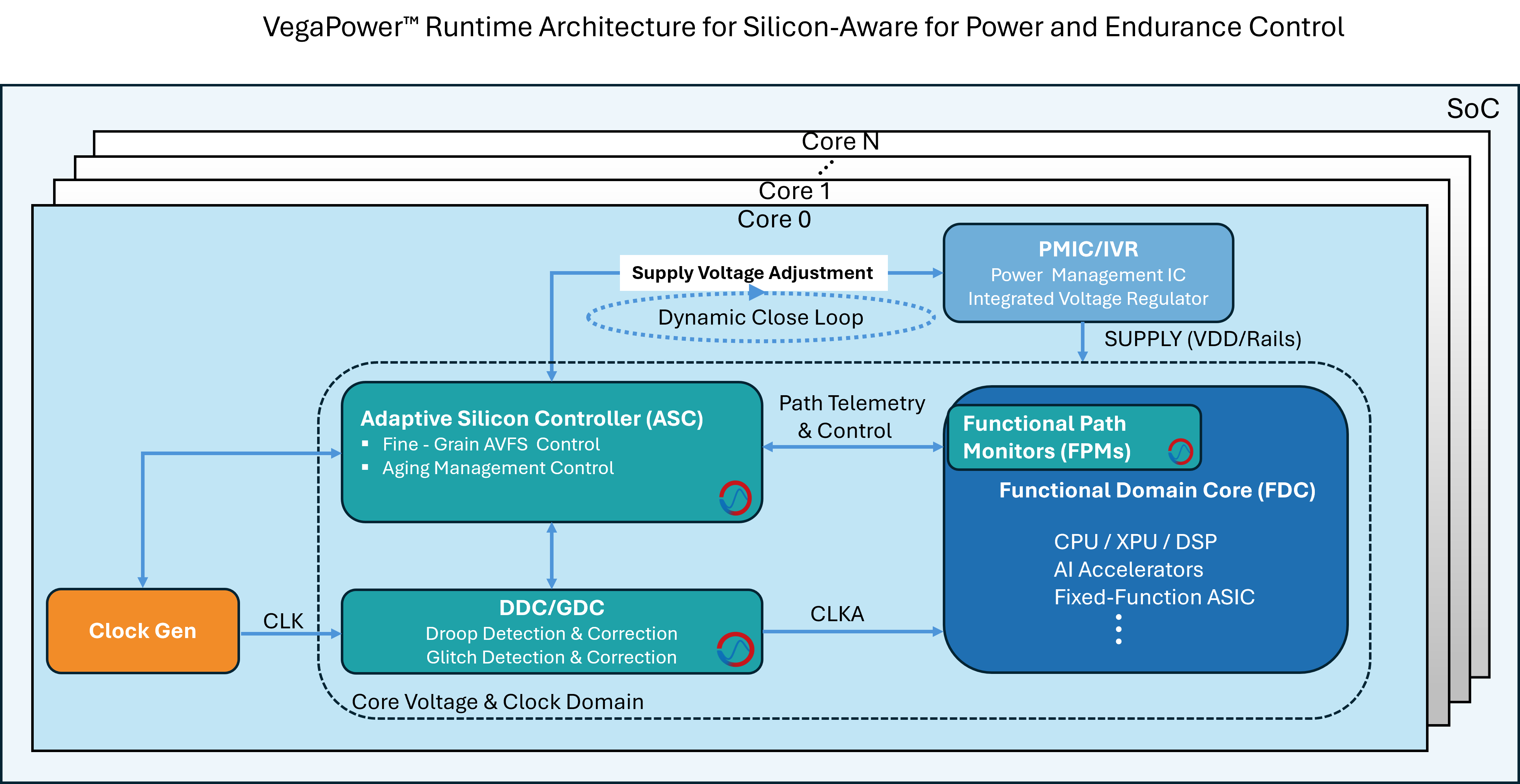
Observes timing stress from functional execution behavior instead of relying only on external proxy sensors.
Supports more accurate voltage and frequency decisions based on real silicon conditions.
Enables local response to transient supply events that external regulators cannot address quickly enough.
Tracks margin behavior over aging, thermal change, workload variation, and operating history.
Reduces conservative voltage margins caused by uncertainty in process, droop, aging, and workload behavior.
Designed to complement existing PMU, DVFS, AVFS, SLM, and implementation flows.
VegaPower is designed to improve efficiency while also reducing broader platform cost and complexity.
Reducing voltage guardbands directly reduces dynamic power because power scales approximately with V².
Runtime margin visibility allows silicon to operate closer to true limits without relying on worst-case assumptions.
Fast local droop response and better runtime control reduce peak-current uncertainty and transient margin burden.
Less conservative droop guardbanding can reduce dependence on excessive on-die and package decoupling.
Local silicon response can reduce the burden placed on external or integrated voltage regulation loops.
Lower voltage and thermal stress can reduce lifetime degradation and improve aging-aware operation.
Runtime silicon truth can support more accurate characterization of real operating margin.
Runtime margin visibility helps reduce guardband-driven overdesign, excessive buffering, leakage overhead, and timing-closure pessimism while improving signoff confidence and accelerating time to market.
VegaPower is designed to work with modern SoC power management, silicon lifecycle management, reliability monitoring, DVFS / AVFS control, PDN design, and advanced-node implementation flows.
Explore how VegaPower™ enables execution-coupled power intelligence for advanced SoCs operating under real workload, voltage, thermal, and aging conditions.